Mongolian fairy tales are an important genre of the oral prose literature of the Mongolians. These tales typically begin with the phrase “Once upon a time, in such-and-such a place, in such-and-such a country”. Mongolian fairy tales are symbolic. This symbolism always becomes clear at the end of the tale. The most frequent ending is “and they lived happily ever after.” This end has the double sense of expressing the wish of the hero and the readers of the tale. The fairy tales of Mongolia can be classified into
the four categories:
1. Parables or fables
2. Magic tales
3. Heroic tales
4. Witty narratives
These classifications refer to the meanings of the tales and the actions of the protagonists and villains.
Parables and Fables
Wild beasts, antelopes, and domestic animals are personified, behaving like human beings. Only animals are the heroes of the development of these stories, which is why they are called animal parables. The Mongolian animal parables are totally allegorical. The animals in these tales express the sarcastic and humorous sides of humans.
For instance:
The Wolf is an allegory of hunger.
The Fox is an allegory of slyness.
The Bear is an allegory of power.
The Tiger and Lion are allegories of fierceness.
The Hare and Hedgehog are allegories of wittiness and wisdom.
Domestic animals are allegories of good-heartedness, kindness, and generosity.
The Silly Wolf (Fairy Tale)
 It is said that once upon a time there was a wolf walking along the road. He
found a piece of sheep’s intestine and decided to eat it. But the intestine
spoke to him, saying, “Wolf, do not eat me. To the south, there is a horse
that fell and is stuck in the mud. Please eat him.” The Wolf obeyed the
word of the intestine and went to the place that the intestine pointed out.
There indeed was a horse stuck in the mud. He moved in to eat the horse,
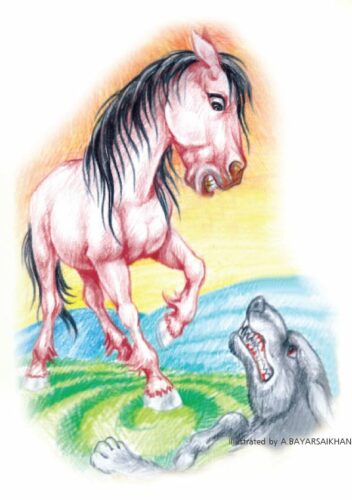
but the horse said, “Dear Wolf if you want to eat me. First, take me out of the mud and then eat me please.” The Wolf accepted the request of the horse and took the horse out of the mud. The horse said, “If you want to eat me, first clean the mud off of me.” As the horse had requested, the wolf cleaned the horse by licking the mud and then tried to eat him. But the horse said, “There is a letter in my hind hoof. Please read it first and then you can eat me.” The Wolf went to the hind feet of the horse to look for the letter, but the instead horse kicked the Wolf hard and then ran away. Before his death, the Wolf said, “Addled noodle who was walking along the
road and was created by the sheep intestine, why did I let that happen? Why did I take the horse out of the mud? Am I the owner of the horse? Why did I lick the mud off of the horse? Am I the mother of the horse? Why did I try to read the letter in the hoof? Am I literate?
• Magical or Wondrous Fairy Tales
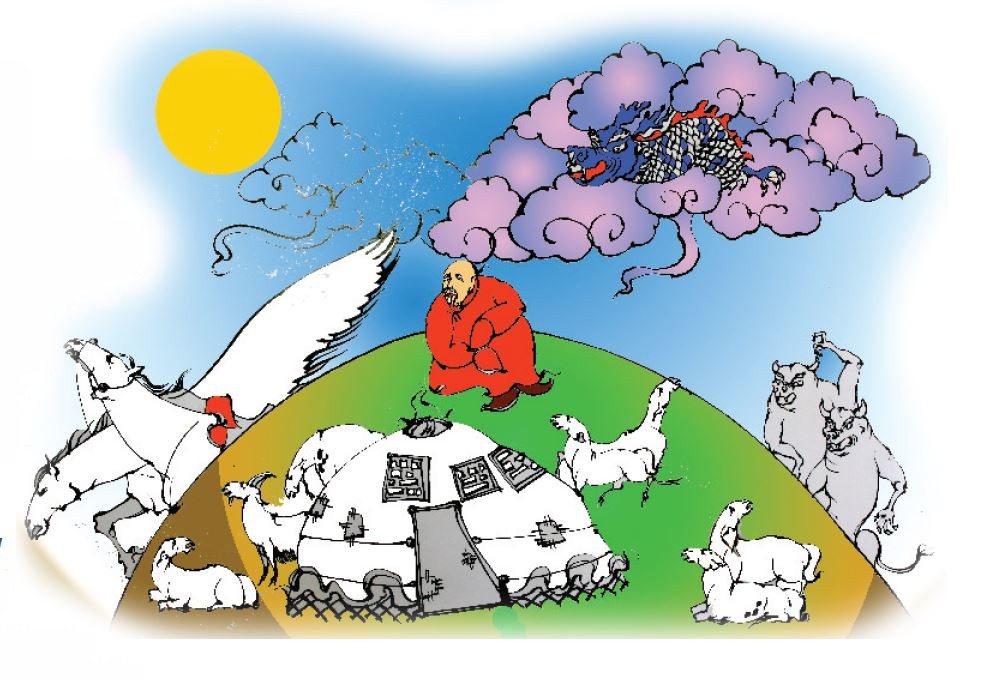
The protagonists of most Mongolian magical or wondrous tales are mainly kings or knights who had gone to fight in distant places. These stories often include the appearance of monsters, devils, demons, apparitions, and ghostly beings. There is also the use of white magic, such as racing horses that can fly and other such beings. In the fairy tale of the golden and silver ankle bones of a cow, there is an eight-footed horse. In the fairy tale of the mischievous old fellow, there is a horse that flies. The eight-footed horse means that he is the swiftest horse on earth.
A Mischievous Old Fellow
Once upon a time was an old man whose name was (Boldoggüi Bor Övgön), a mischievous old fellow. This old man had seven brown ewes and two grey horses. One horse could fly but the other could not. The mischievous old fellow lived in a hut on a hill where he tended to his seven brown ewes. His flying grey horse was hitched to the western side of his hut and his non-flying grey horse was tethered to the eastern side of his hut. The mischievous old fellow said to himself that he should let the small-eared brown ewe put forth a white-faced lamb. “I want to immolate it to the goddess Indra (The Lord of Heaven),” he said. One day, the small-eared ewe gave a birth to a white-faced lamb and the mischievous old fellow determined to offer it as a sacrifice. He put this lamb in a bag and put it beside him as he spent the night under the stars. But a carrion-crow from the goddess Indra flew in and pecked out the eyes of the white-faced lamb. The mischievous old fellow became furious by this and mounted his flying grey horse and flew to the next of the carrion-crow where he replaced the bills of the crows with wooden bills. After this, Indra sent out two wolves to eat the mischievous old fellow’s flying grey horse, but the fellow had foreseen this and had switched his two horses. He tethered his non-flying grey horse to the eastern side of his hut and his flying grey horse to the western side of his hut. The two wolves came and ate his non-flying grey horse and went away. The mischievous old fellow then mounted his other flying grey horse and went to overtake the two wolves. When he came upon them he flayed these wolves’ skins up to their snouts. The goddess Indra was determined to subdue the mischievous old fellow and sent out his two devils. One was named Orion-headed, the other was named Pleiades-headed. The mischievous old fellow was boiling horses cuds. The two devils arrived at his hut, pierced the walls of his hut, and looked inside. The mischievous old fellow threw the boiling cuds and scalded their eyes and faces. After this, the goddess Indra became even more furious and sent out two dragons. The mischievous old fellow had foreseen this, too, while tending to his seven brown ewes on the hill, and he erected a brown scapegoat filled with Betula exilis and crept away to hide. The two dragons struck the hut with lightning, reducing it to the burnt coals. The mischievous old fellow mounted his flying grey horse and overtook the dragons, cutting off their tails. Indra became even more furious and sent out a messenger to summon this mischievous old fellow with the purpose of executing him. The mischievous old fellow came to the home of Indra upon the summons. Indra asked, “Why did you replace the horny bills of the
crows with the wooden ones? The mischievous old fellow replied, “I said to myself that I should let the small-eared ewe put forth a white-faced lamb. If she does this then I would sacrifice it to the goddess Indra. The ewe gave birth to the white-faced lamb. I was happy, but then the carrion-crow flew in and pecked out the lamb`s eyes. Then I got angry and replaced their bills.” Indra said, “In this case, what you did was correct, but why did you flay the skins of the two wolves up to their snouts?”
The mischievous old fellow responded by asking, “Did you not send them to eat up my flying grey horse?” Indra replied, “I sent them to eat up the flying grey horse.” The mischievous old fellow replied, “So your wolves ate my non-flying grey horse. So I did it.” Indra replied, “You are correct.” Then Indra asked, “Why did you scald the faces of my two devils?” The mischievous old fellow asked, “Did you not send them to harm me or pierce the wall of my hut?” Indra replied, “I sent them to harm the mischievous old fellow.” The mischievous old fellow said, “They pierced the wall of my hut instead of harming me. So I scalded their eyes and faces.” Indra replied, “You are correct.” Indra asked, “Why did you cut off the tails of the two dragons?” The mischievous old fellow asked, “Did you not send them to strike me or my hut by lightning?” Indra said, “I told them to strike the mischievous old fellow by lightning.” The mischievous old fellow replied, “They struck my hut on the hill with lightning instead of striking me. So I cut off the tails of the two dragons.” Indra said, “So you are correct.” After this, the mischievous old fellow with his seven brown ewes and flier grey horse lived happily ever after.
• Heroic Tales
These tales retained the heroic manners in the poetic tunes and epic deeds. There are many heroic tales.
• Witty Narratives
The works in this genre express the conflicts and witticisms experienced in the everyday lives of the nomadic herders. These tales are often humorous and include frequent descriptions of animals, hunters, mendicant Lamas, and noblemen and officials. In them, we find popular symbolism of nomadic herders’ ways of life. In these tales, there are struggles for power and authority, longings for offspring, greed, and avarice. These tales usually circle around questions of morality.
Tale of the Witty Daughter-in-law
Once upon a time, there was a king who had a stupid son. One day he heard of an old man who had a witty daughter. The king decided to marry his stupid song to this witty daughter and so-called for this old man. The king said to him, “You, old man, bring me an ash hobble with three legs. You must look for it along neither a road nor a non-road. You must walk neither with boots nor without boots. And you must do this neither by day nor by night, and neither outside nor inside. If you make a mistake, your head shall be cut off.” The old man was scared out of his wits and told the king’s order to his wise daughter. The daughter told her father not to worry. It will be easy to solve, she said, and then told her father how to reply to the king. The next morning the old man went to the king to complete the king`s order in the manner that his daughter had told him to.
The old man said to the king, “Dear sir, I brought an ash hobble
with three legs as you ordered. Look at it, please.”
The king shouted, “At where are you?”
The old man answered, “I am neither inside nor outside,
but I am between the wood-framed wall and the felt cover.”
The king asked, “When did you arrive?”
The old man answered, “Neither day nor night. I arrived
at dawn.”
The king asked, “Which way did you arrive?”
The old man answered, “Neither by a road nor by a nonroad. I arrived along the narrow trail.”
The king asked, “How did you make a hobble with three
legs?”
The old man answered, “I made a hobble with three legs and placed it on the flat stone. I then burned this hobble and now it is an ash hobble. So, your majesty, you can hobble your horse with it if you favor it.”
The king said, “Old man, I will come to your home. You must give me milk from an ox. If you cannot do this your head would be cut off.”
The old man thought that the king had become crazy and was in despair. But when he came to his home and told his wise daughter about the king’s order, she said, “That is not difficult, daddy, do not worry. I can find out a way to do that.”
The next morning his daughter caused her father to lean over a pannier and draped a gown over him at the base of the ger. Suddenly somebody called out, “Hold your dog.” The daughter pushed out the capital of the column and went out
of her ger.
“Nobody can enter,” she said.
“Why? What has happened?” the king asked.
The daughter answered, “My father has given birth to a
child.”
“Does a man give birth to a child?” the king asked.
“Does an ox give milk?” the daughter replied.
The king was silent and then returned to his palace. He
thought that this girl was witty enough and made up his mind
to marry this girl to his stupid son. He supposed that she might
have a great hold over him when they married.
One day the king said, “Son, can you saddle a horse with
two heads for me?”
The son said he could and placed two horses in opposite positions
and bound them with cinches. But the cinches snapped.
He tried again and again, but each time he failed.
Then the stupid prince said to his wife, “My father told me
to saddle a horse with two heads. I tried and failed. What can
I do?”
The witty wife said, “You may saddle a mare to a foal.”
As his wife said, the prince saddled a mare to a foal. Then
the king asked his song to boil meat in a wooden kettle. The
prince said he could, but then when he tried burned all his
wooden utensils. It was impossible to boil meat in a wooden
kettle. When the prince told this to his wife, she said, “Please
pierce the meat with the dwarf cornel skewer and roast it.”
The prince did as his wife said. The king then told him to
make a man of ice and said, “My son, ask a word and learn it
from the man of ice.” The stupid prince tried but could not get
the man of ice to say a word, so he broke it to pieces and said
to his wife, “My father told me to make a man of ice and ask a
word from it. The man of ice did not say any word, so I broke
it to pieces.” Then his wife said, “Tell him: My body consists of
water. The nature of water is icy. In winter for three months
there is ice. In summer for three months this ice thaws.” The
prince told these words to his father. The king said, “Son, you
have married a witty wife and has a great influence on you.
Now you are able to ascend to the throne and to govern others.”
One day the king was hunting on another’s territory. But two men, who wanted to occupy the king’s throne, arrested him. The king said, “My banner people do not believe easily. They are serious. They do not believe that I can be arrested by
two men. Let me give you a note that I am well.” The two men accepted this offer.
This letter he wrote, however, stated: “I have a blue vault over me and a green silken lawn under me and ten men supporting me at my back. I always have two milk skins of milk and plenty of mutton. I live happily. Please drive horned animals
before you. Drive hornless animals behind you, and fold your white hair. There are two aspens. You do not feel these aspens. They are local spirits. Hew one of these in the middle of the locality. Our local spirits will chase after them. Please come here by using one of these as fuel. Nobody can understand this letter. Do not show it to anyone. There is a black silken file at my son’s feet. My daughter-in-law knows it. Let her find this file. She can file the lock and open the chest and then see what
is inside of it.”
The two men came and showed the letter. Those who saw this letter believed that the place where the king was was very nice. Some even wanted to move there. But the daughter-in-law asked to see the letter. After she did she spoke before the
audience and deciphered the real meaning of the letter.
“My dear audience, you believed that my father-in-law is living happily. As I understood, some of you even wanted to move there. Indeed my father-in-law is not living happily. His blue vault above him means space. Green lawn under him means green grass. His ten men supported my back means that his arms were pinioned on his back with straps. Drive horned animals before you mean that those who have guns and spears go in the front, and drive hornless animals behind means that people with no guns go behind those with guns. Staggered red stark means the prince. Keeping a black hare means going in the night. Keep the white hare to conceal a day. The two local aspens mean these two messengers. Hew one and make another
a fuel means one should be killed and another should be made
as a guide.
As the daughter-in-law of the king said, the subjects of the king did. They rescued their king by killing enemies and occupying the territory. After many years king became senile. He needed to transfer his throne to his son, but the prince was
stupid. The king was anxious about the stupidity of his son. Even though the daughter-in-law could not succeed the king, she was genuinely witty. The king considered a way to transfer his power to his daughter-in-law. So he quizzed his daughter-in-law.
The king called on her and said, “You should compose a sentence that does not use the words arag (pannier), sawar (cane gatherer of dung), aduu (horse), khomool (pellets), honi (sheep), huts (ram), chono (wolf), gol (river), mod (tree) nor
idekh (to eat), but this sentence should inevitably need these words. The king gave her a pannier, a dung-gatherer to collect horse’s manure. In the meantime, a wolf came to the flock of sheep and caught a ram and dragged it over the stream and
ate it. The daughter-in-law of the king had to report it without using real proper names.
She said, “When I carried an interlaced basket over my back and held a carved wooden hand and gathered runner’s waste, a howler appeared and apprehended the father of the bleaters. It forded the current and guzzled it near the tallest plant.” The king was very glad and amazed at her wit and gave his throne to her. Then they lived happily ever after.
• Humorous Tales
The humorous tales are often full of parody and humorous devices.
The Pudgy Boy who Rode a Stumpy Yearling Colt
Once upon a time during the Manchu period, a nobleman assailed the common people with insults. There was a pudgy boy, riding a stumpy yearling colt, galloping along the rutty road with his whip. The boy saw a field mouse whisk straight
into its burrow. The boy stopped and dismounted from his yearling colt and started digging and smoking out the burrow.
But then the king’s horseman, with a furry overcoat made of goatskin and riding on a black stallion, came and asked, “What are you doing?” The boy answered that a field mouse had whisked into the burrow. “Now I am digging and smoking the burrow.” The horseman said, “You, who uttered the witty words. Heaven may strike you with lightning.” The boy answered, “Heaven might strike you who are riding the stallions and striking them with their thick crest. It may spare me, who is orphaned.”
The horseman was enraged by this and wanted to inform his nobleman. But the nobleman was not at home. Then he told the nobleman’s wife about the boy. The wife sent out a messenger to bring him. The boy said, “The head of a goat
is less respectable at the sacrifice. The head of a camel is too big to place on a tub. The fatty wife is not entitled to become involved in a suit. The head of a sheep can be placed at the sacrifice. I can be punished by the nobleman who is entitled
to penalize.”
The boy was stripped of his clothing and then hitched to a horse-hitching pole. He shuddered with cold. The doctor of the nobleman came and asked, “Why are you here?” The boy answered, “I am picking the doctor’s thumb, a writer’s pointing finger, and the dry skull of a clergyman.” But the nobleman came and asked, “Why is he hitched.” The boy said that he argued with a nobleman’s horseman and the nobleman’s wife and explained his arguments. The nobleman said that boy was correct.