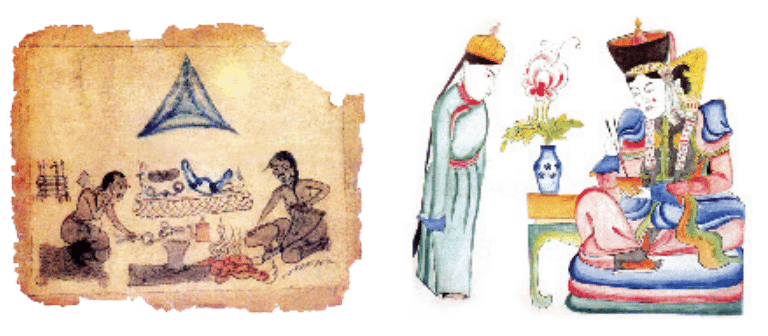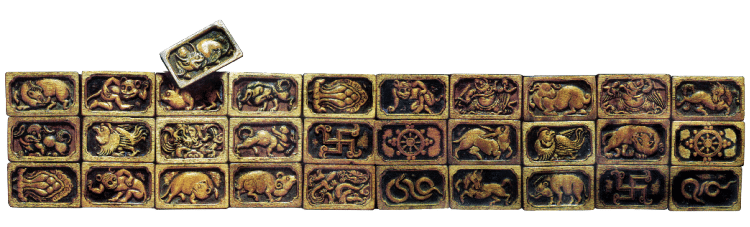
Mongolian traditional games are not only forms of competition. Their cards, boards and playing pieces can also be works of visual culture. Hand-painted sets preserve images of animals, landscapes, social ranks and beliefs associated with nomadic life.
Art made to be handled
Unlike a painting displayed permanently on a wall, a game card is shuffled, counted and shared. Artisans therefore had to make images readable at a small scale while using materials such as paper, leather, wood or felt. Repeated handling also means that surviving historical sets are valuable records of everyday art.
Painted cards and social observation
Some Mongolian card sets depict rulers, officials, guards, servants and other figures. The images may communicate rank through clothing, posture and objects. They can also contain humor or satire, allowing artists and players to observe social differences through play.
What is üichüür?
Üichüür is a traditional game using elongated painted cards associated with animals and numerical values. Sets vary, and descriptions do not always agree on every rule or total. Museum collections commonly show birds, rabbits, deer, foxes, snow leopards, tigers, lions and other creatures arranged in a hierarchy of scores.
Animal imagery and the nomadic world
The animals are not random decoration. They reflect close observation of movement, habitat and relative power. A small bird and a predator occupy different positions in the game just as they do in stories and ecological knowledge. Painted landscapes place them in recognizable worlds of mountain, forest and steppe.
Symbolism beyond entertainment
Research catalogued by the International Research Centre for Intangible Cultural Heritage links üichüür with hunting traditions, trade and the symbolism of the number eight. Related games such as khorol may be played around Tsagaan Sar and express wishes for good fortune, household continuity and the cyclical calendar.
Collections and preservation
The Fine Arts Zanabazar Museum and other Mongolian collections preserve examples of game-related painting. Digital museum records now allow wider audiences to study individual pieces, but the living knowledge of how sets are made and played is equally important.
Why game painting matters
These objects join craftsmanship, storytelling, mathematics and social interaction. They show that Mongolian art was never limited to formal religious painting or elite portraiture. It also lived in the hands of players, in family gatherings and in the visual imagination of everyday life.
How üichüür is played
Published rule descriptions vary, but play generally depends on the rank and numerical value assigned to illustrated animal cards. The visual hierarchy helps players remember value while making the set enjoyable to handle. A surviving museum set may be incomplete, so its images should not automatically be treated as a universal deck.
Evaluating a handmade set
Look for clear imagery, consistent dimensions, durable material and a written explanation of the rules. New sets may preserve traditional motifs while using modern paper, print or protective finishes. That does not make them inauthentic, provided the maker describes the materials honestly.
Frequently asked questions
Is üichüür the same as khorol?
No. They are distinct games, although both appear in discussions of Mongolian symbolic game pieces and holiday play.
Are all old cards religious objects?
No. They may carry symbolic imagery without functioning as ritual objects.
Can historic sets be played?
Museum objects should be preserved. Reproductions are better for learning the rules through play.
Historical images