
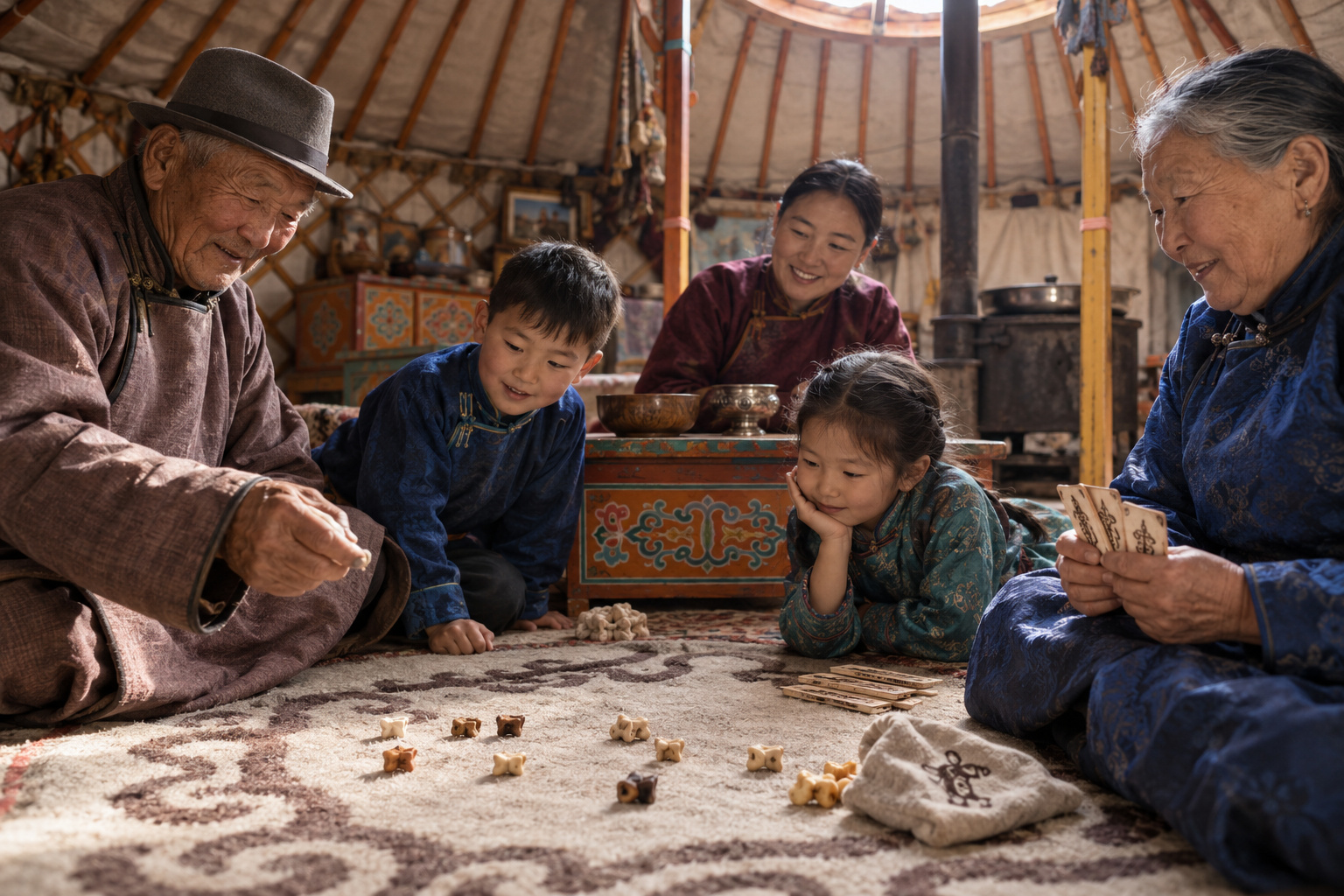
Mongolian games and toys grew from the materials, spaces and skills of pastoral life. Sheep anklebones became counters and projectiles; wood became miniature animals and boards; felt became balls and dolls. Many games could be packed quickly, played inside a ger or adapted to open ground.
These traditions are diverse rather than one official collection. Names and rules change by region, family and generation, and contemporary children move easily between inherited games and digital or international play.
Quick answer: what are traditional Mongolian games?
The best-known include shagai anklebone games, anklebone shooting, khorol tile games, Mongolian chess, riddles, finger games, racing games and physical contests that imitate riding, herding or hunting skills. Toys often represent the five livestock species, carts, saddles and household objects.
Shagai: one object, many games
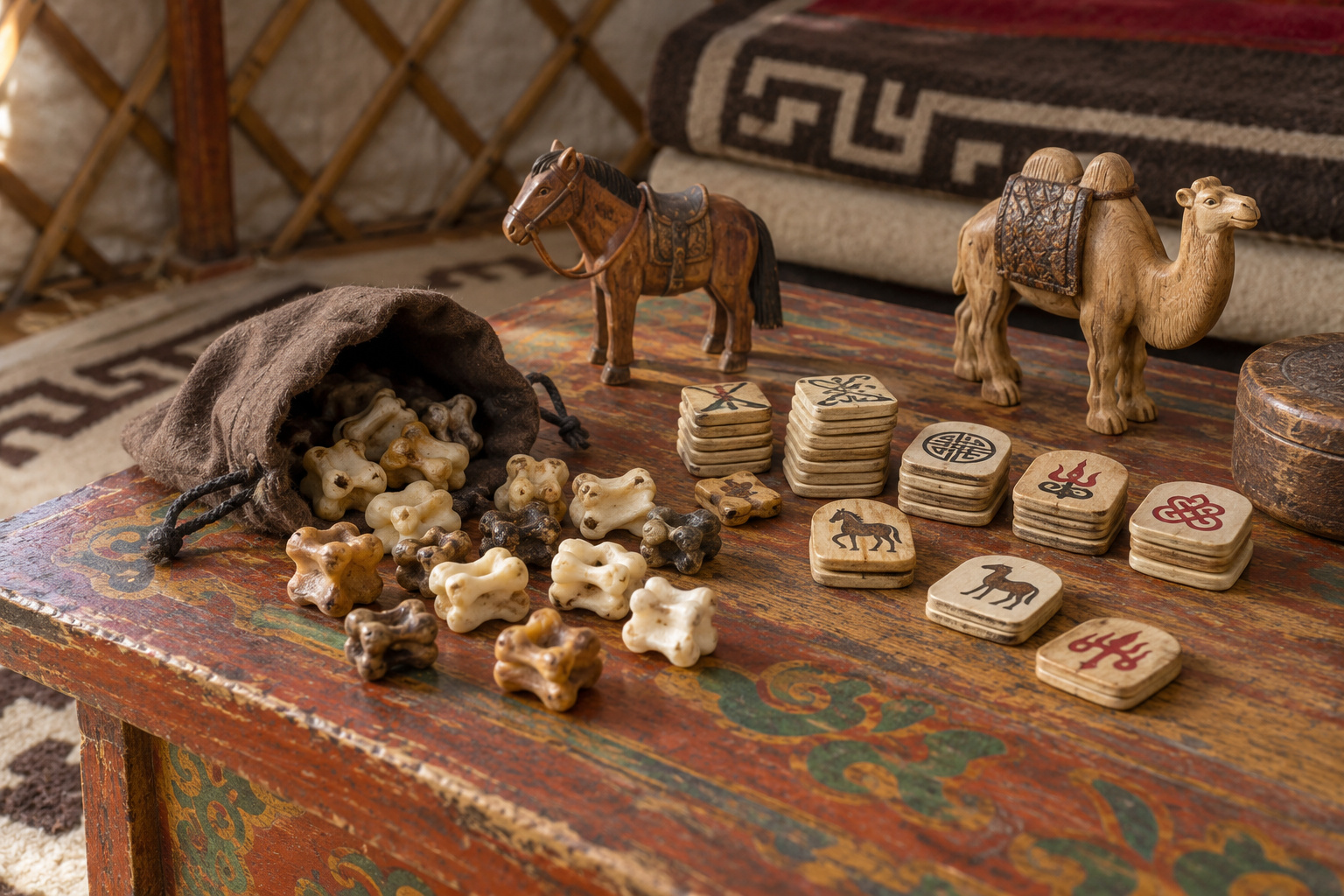
A sheep or goat anklebone has four stable sides conventionally named horse, camel, sheep and goat. Players can toss bones like dice, race “horses,” flick one bone at another, sort herds or tell stories with the pieces. Rules range from quiet counting games for young children to highly skilled competitions.
Clean, smoothed pieces are important. Very small bones can be a choking hazard and should not be given to children who still put objects in their mouths.
Mongolian knuckle-bone shooting
In team anklebone shooting, adults use a smooth shooting tool to strike small targets across a set distance. Teammates produce distinctive vocal encouragement while judges watch accuracy and order. UNESCO inscribed Mongolian knuckle-bone shooting on the Representative List of the Intangible Cultural Heritage of Humanity in 2014.
It should be practiced in a controlled lane with spectators behind the players. Historical descriptions of improvised projectiles are not safety instructions.
Khorol
Khorol is played with carved or painted pieces bearing symbolic designs. Players build combinations and compare sets according to locally taught rules. The tactile pieces, repeated motifs and winter gathering around the game make khorol both recreation and a vehicle for family teaching.
Surviving sets vary, so a modern reproduction should identify the rule tradition it follows rather than claiming to be the only authentic version.
Shatar: Mongolian chess
Mongolian chess uses the familiar strategic structure of chess but may give pieces local names and carved forms. A rook can resemble a cart, while other pieces may appear as horses, camels or nobles depending on the set. See our dedicated guide to Mongolian shatar for the board, pieces and cultural history.
Wooden animals and miniature households
Small horses, camels, sheep, carts, saddles and ger furnishings let children rehearse scenes they observe around them. A toy herd can become a counting lesson, a story or a model of seasonal movement. Makers may carve one piece at a time from offcuts, leaving tool marks that distinguish the object from factory plastic.
Felt dolls, balls and soft toys
Wool scraps can be rolled or stitched into balls, animals and dolls. Felt is light, repairable and familiar from household work. Today’s makers combine old material knowledge with safe stuffing, secure seams and washable construction.
Movement games
Outdoor games develop running, balance, throwing and teamwork. Some imitate catching horses or guarding a herd; others resemble tag, relay races or wrestling. Their value lies not in preparing every child for a fixed nomadic role, but in turning local movement and language into shared play.
Riddles, fingers and wordplay
Not every game needs an object. Riddles teach metaphor and observation; finger games coordinate speech and movement; tongue twisters reward rhythm and pronunciation. These forms are easy to pass between generations and can survive even when families move to apartments.
What games teach
- Counting, probability and grouping through anklebones
- Fine motor control through flicking, stacking and carving
- Strategic thinking through boards and tiles
- Vocabulary and memory through riddles and songs
- Cooperation, turn-taking and gracious winning
Buying or collecting responsibly
Ask what material was used, who made the set and whether rules are included. Avoid pieces taken from archaeological or sacred contexts. For children, check for sharp edges, loose paint, choking-size parts and finishes that are not intended for toys.
Frequently asked questions
Are shagai bones real?
Traditional pieces are cleaned sheep or goat anklebones. Modern sets may use resin, wood or other materials.
Is anklebone shooting the same as children’s shagai?
No. It is a formal team discipline with specialized equipment and rules, while shagai refers to many games.
Do Mongolian children still play these games?
Yes, especially at family gatherings, schools and festivals, although frequency varies and modern toys are also common.
Sources and related reading
Read UNESCO’s entry on Mongolian knuckle-bone shooting, our complete guide to shagai games and our article on Mongolian chess.
Comments are closed.