
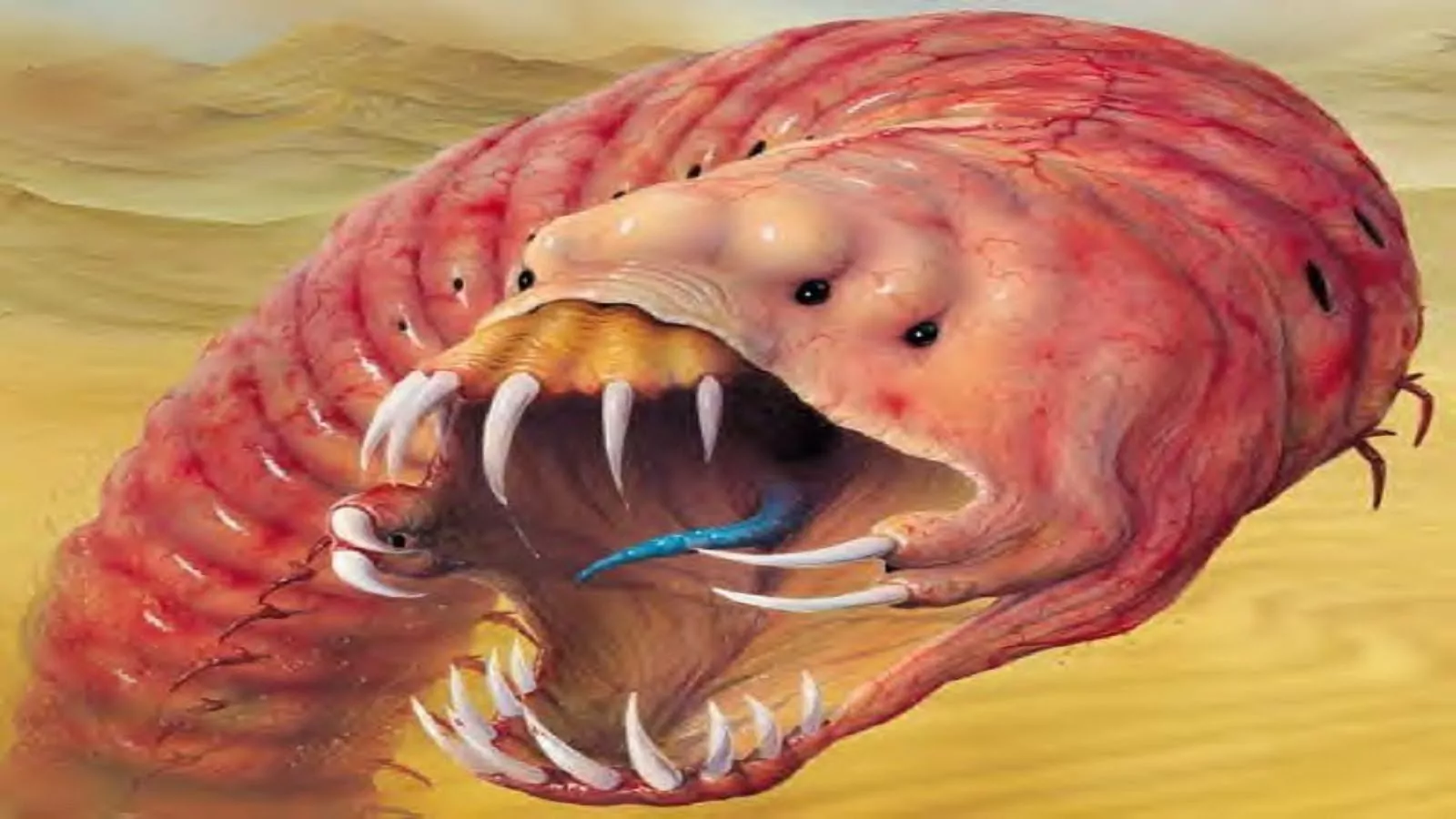
Death worm is known as meter-long red worm-like creature that is found in the Mongolian Gobi. But there is no real history of it, and many years of research have not confirmed it. It is believed that there are death worms in most of the Gobi Desert, and the former Prime Minister of Mongolia, Ts. Damdinsuren first described it to Western scientists in 1922.
Scientists, on the other hand, believed that is just a myth. Researchers, adventurers, travelers, and zoologists from many countries have traveled to the southern Gobi Desert to study the death worm, but no one has seen them. The story of the deadly worm has been told to Mongolians for generations. The creature first came to Western attention as a result of Roy Chapman Andrews‘s 1926 book On the Trail of Ancient Man. The American paleontologist described second-hand tales of the monster that he heard at a gathering of Mongolian officials: “None of those present ever had seen the creature, but they all firmly believed in its existence and described it minutely.
Czech zoologist Ivan Mackerle is one of the leading researchers in the study of death worms. He heard about a deadly worm from a student and traveled to southern Mongolia in 1990 to study more. The locals were afraid to talk about the deadly worm, and the government’s ban on researching and talking about the worm made it even more difficult for them to unravel the mysteries hidden in the Gobi. However, the ban was lifted and he continued his journey.
In his book “Mongolské záhady” translated as “Secret in Mongolia”, he described the deadly worm as “sausage-shaped, half a meter long creature like a cow’s large intestine. It has scaly skin and a short tail that looks like it has been cut off. It’s hard to say which is the tail and which is the head. ” He never confirmed it himself but described the creature as real.
Dr. Karl Shuker, a British zoologist, and author of, “The beasts that hide from man” described the legendary deadly worm as “one of the most famous animals in the world. It hides under the sands of the southern Gobi. It spends most of its life in the dune, but lying on the sand scares everyone.” Although they move underground like lizards, they often appear in June and July. Some scientists have observed that this may be because the surface is moist and wet. Shuker has never seen or confirmed a death worm but speculated that it may be a lizard that lives in hot climates. The worms can generate a lot of electricity from their bodies. AD Simukov, a Soviet scientist who worked in Mongolia in the 1930s, left an interesting fact in his travel diary. He said, “The worms are common animals in the Saxaul and Suuj Gobi. People talk about him a lot, and they are very scared. This animal usually comes to the surface when it is raining or when the ground is wet. It wraps its entire body around the animal when eating and swallows it whole after choking. It is said that this animal is found only in the Mongolian Gobi Desert. It is believed that if you meet this worm in the desert, you will not survive. The worm spread its cyanic like a toxin in a circular way the size of a ger and soon any animals and people around him lose consciousness for a moment and fall. The worm comes to the surface during its reproduction period and is very dangerous if encountered during this time. Normally, it is light in color, and when angry, it turns red and emits millions of drops of toxins from the mouth. The poison is like cyanic acid.
Soviet scientist Ivan Efremov also wrote an article about the death worm, as well as about the death of two co-researchers on his expedition. “… It’s weird, it’s like a sausage,” the driver whispered in my ear. It had no legs, no mouth, no eyes, it was a meter long, and looked like a sausage. Head and tail were indistinguishable. They were two fat snake-like creatures curled up in the sand. When our Grisha jumped out of the cab, our operator shouted, “Don’t shoot, catch him alive,” and ran after him. At that moment, the old Mongolian man beside me grabbed my hand and looked at me with a frightened look, and begged, “Leave it, there will be a death, call them back.” So I called out Grisha and Misha, “Come back,” but they kept running to that animal, not knowing if they heard me. Suddenly, two worms formed a ring, which immediately turned dark blue. At first, Misha fell silently on the sand and became completely motionless. After a while, Grisha fell to the same place. I took my pistol and ran after them but the two worms were already gone. Unfortunately, our co-workers were already dead due to toxins.